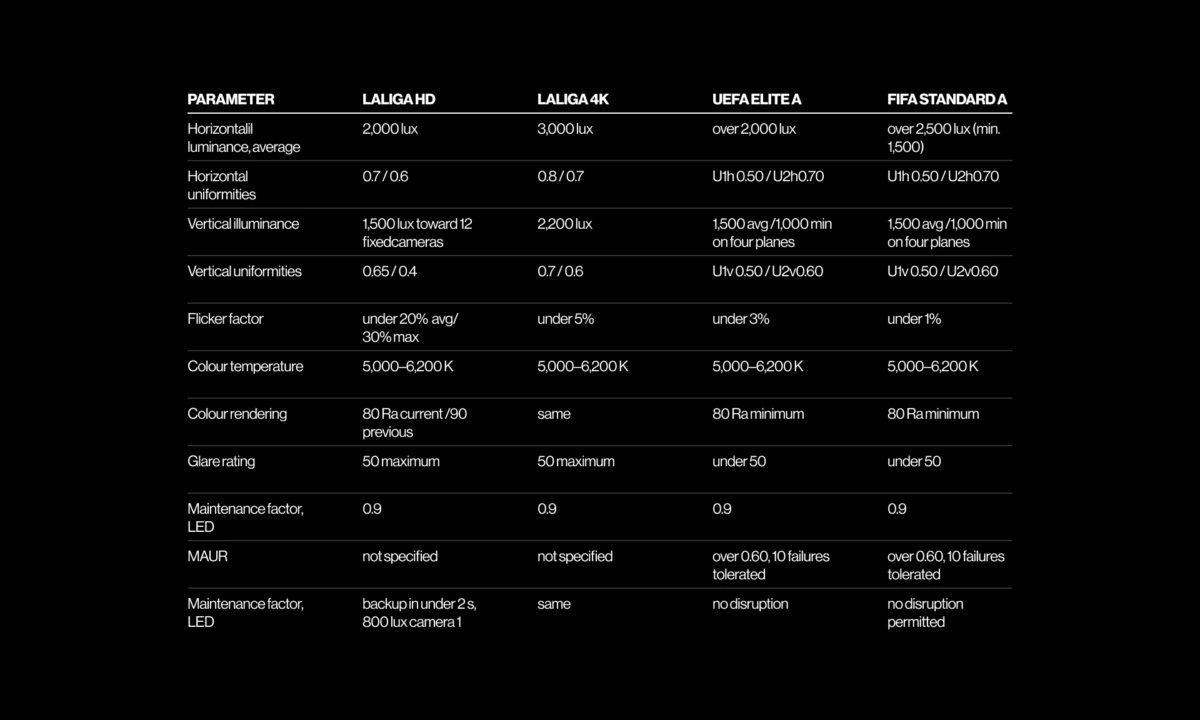
Three bodies, three documents, three different questions
The three sets of requirements exist because the three bodies are protecting three different things, and each one is a licence to host something different.
LaLiga protects its broadcast product. Its television broadcasting regulations are written from the camera position outward: the league sells a television signal, and the lighting is what makes that signal saleable. It sets one level as the competition minimum, and a stricter one above it — LaLiga 4K, the highest standard in Spain — for the fixtures the league produces in 4K each week.
UEFA protects competition integrity across dozens of venues in dozens of countries. Its Stadium Lighting Guide sets requirements by level. Elite level A is the highest in Europe, and it is what qualifies a venue to host a Champions League, Europa League or Conference League final, or a European Championship final.
FIFA protects the tournament. Its Lighting Guide sets standard A, the highest level FIFA imposes, and the one that qualifies a venue for World Cup matches.
Two terms decide how the table reads. Horizontal illuminance is the light landing on the grass. Vertical illuminance is the light arriving on the player — what the camera actually sees, and the figure that decides whether a picture is usable.
One requirement sits outside the table because it is procedural rather than numerical: LaLiga measures every stadium before every season. Compliance is an annual audit, not a launch event.